

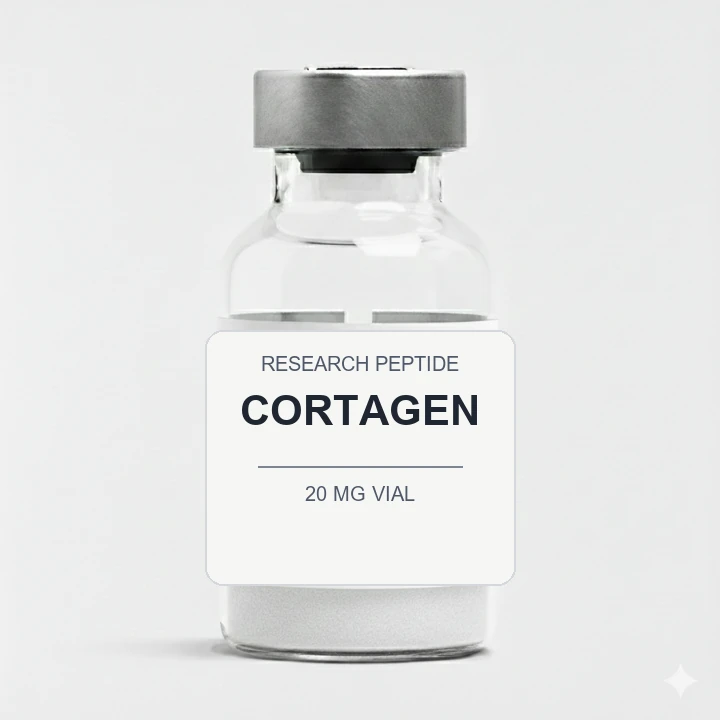
Quickstart Highlights
Cortagen dosage protocols are designed around this synthetic tetrapeptide (Ala-Glu-Asp-Pro) that belongs to the Khavinson bioregulator class, studied for its neuroprotective and neuroregenerative properties[1][2]. Research indicates Cortagen may support peripheral nerve regeneration, enhance cognitive function, reduce oxidative stress in neural tissues, and promote cellular repair mechanisms without significant adverse effects at therapeutic doses[3][4]. This educational protocol presents a once-daily subcutaneous approach using a practical dilution for clear insulin-syringe measurements.
- Reconstitute: Add 3.0 mL bacteriostatic water → 6.67 mg/mL (6670 mcg/mL) concentration.
- Typical daily range: 1000–2000 mcg once daily (morning administration preferred).
- Easy measuring: At 6.67 mg/mL, 1 unit = 0.01 mL ≈ 66.7 mcg on a U-100 insulin syringe.
- Storage: Lyophilized: freeze at −20 °C (−4 °F); after reconstitution, refrigerate at 2–8 °C (35.6–46.4 °F); avoid freeze–thaw cycles.
Dosing & Reconstitution Guide
Educational guide for reconstitution and daily dosing
Standard Approach (3 mL = 6.67 mg/mL)
| Week | Daily Dose (mcg) | Units (per injection) (mL) |
|---|---|---|
| Weeks 1–2 | 1000 mcg | 15 units (0.15 mL) |
| Weeks 3–4 | 2000 mcg | 30 units (0.30 mL) |
Frequency: Inject once daily subcutaneously, preferably in the morning[5]. This schedule uses the largest practical dilution (3.0 mL) to keep per-injection units ≥15 for accurate measurement. For doses under ~10 units (<700 mcg), consider using 50-unit or 30-unit insulin syringes for improved readability.
Reconstitution Steps
- Draw 3.0 mL bacteriostatic water with a sterile syringe.
- Inject slowly down the vial wall; avoid foaming.
- Gently swirl/roll until dissolved (do not shake).
- Label and refrigerate at 2–8 °C (35.6–46.4 °F), protected from light.
Supplies Needed
Plan based on a 4-week daily protocol with gradual titration (1000–2000 mcg/day).
-
Peptide Vials (Cortagen, 20 mg each):
- 4 weeks ≈ 3 vials (at average 1500 mcg/day = 42 mg total)
- 8 weeks ≈ 5 vials
-
Insulin Syringes (U-100):
- Per week: 7 syringes (1/day)
- 4 weeks: 28 syringes
- 8 weeks: 56 syringes
-
Bacteriostatic Water (10 mL bottles): Use 3.0 mL per vial for reconstitution.
- 4 weeks (3 vials): 9 mL → 1 × 10 mL bottle
- 8 weeks (5 vials): 15 mL → 2 × 10 mL bottles
-
Alcohol Swabs: One for the vial stopper + one for the injection site each day.
- Per week: 14 swabs (2/day)
- 4 weeks: 56 swabs → recommend 1 × 100-count box
- 8 weeks: 112 swabs → recommend 2 × 100-count boxes
Protocol Overview
Concise summary of the once-daily regimen.
- Goal: Support neural regeneration, cognitive function, and cellular repair mechanisms over time[1][3].
- Schedule: Daily subcutaneous injections for 4 weeks (extend to 8 weeks if desired).
- Dose Range: 1000–2000 mcg daily with optional gradual titration.
- Reconstitution: 3.0 mL per 20 mg vial (6.67 mg/mL) for accurate unit measurements.
- Storage: Lyophilized frozen; reconstituted refrigerated; avoid repeated freeze–thaw.
Dosing Protocol
Suggested daily dosing approach based on research.
- Start: 1000 mcg (1 mg) daily for Weeks 1–2.
- Target: 2000 mcg (2 mg) daily for Weeks 3–4.
- Frequency: Once per day (subcutaneous).
- Cycle Length: 4 weeks standard; optional extension to 8 weeks.
- Timing: Morning administration preferred; rotate injection sites.
Storage Instructions
Proper storage preserves peptide quality[10].
- Lyophilized: Store at −20 °C (−4 °F) for long-term; 2–8 °C (35.6–46.4 °F) acceptable for short-term (weeks to months).
- Reconstituted: Refrigerate at 2–8 °C (35.6–46.4 °F); use within 4 weeks and avoid freeze–thaw.
- Allow vials to reach room temperature before opening to reduce condensation uptake.
Important Notes
Practical considerations for consistency and safety.
- Use new sterile insulin syringes; dispose in a sharps container.
- Rotate injection sites (abdomen, thighs, upper arms) to reduce local irritation[8].
- Inject slowly; wait a few seconds before withdrawing the needle.
- Document daily dose and site rotation to maintain consistency.
How This Works
Cortagen (Ala-Glu-Asp-Pro) is a synthetic tetrapeptide derived from amino acid analysis of the natural brain cortex preparation Cortexin[3]. It acts as a gene expression modulator and epigenetic regulator, influencing the synthesis of proteins involved in neuronal growth, differentiation, and stress resistance[6][7]. Preclinical studies demonstrate that Cortagen can upregulate neurotrophic factors, reduce oxidative stress markers, and accelerate peripheral nerve regeneration—increasing nerve fiber growth rate and conduction velocity by 27–40% in injury models[1]. In chronic cerebral ischemia models, Cortagen improved behavioral recovery and protected against oxidative damage[2].
Potential Benefits & Side Effects
Observations from preclinical and limited clinical literature.
- Supports peripheral nerve regeneration with improved growth rate and conduction velocity in injury models[1].
- Demonstrates neuroprotective effects in ischemia models by reducing lipid peroxidation and preserving antioxidant enzyme activity[2].
- May enhance cognitive function and memory through promotion of synaptic plasticity and neurite outgrowth[4][5].
- Shows gene expression modulation in cardiac and neural tissues with broad regulatory effects[3][6].
- Generally well tolerated with no significant adverse effects observed at therapeutic doses in animal studies[5].
- Occasional mild injection-site reactions (redness/itch) may occur with subcutaneous administration.
Lifestyle Factors
Complementary strategies for optimal outcomes.
- Maintain a nutrient-rich diet with adequate protein, omega-3 fatty acids, and antioxidants to support neural health.
- Engage in regular physical activity and cognitive exercises to reinforce neuroplasticity.
- Prioritize quality sleep and stress management to support cellular repair and recovery.
Injection Technique
General subcutaneous guidance from clinical best-practice resources[8][9].
Important Note
This content is for educational purposes only and is not medical advice.