

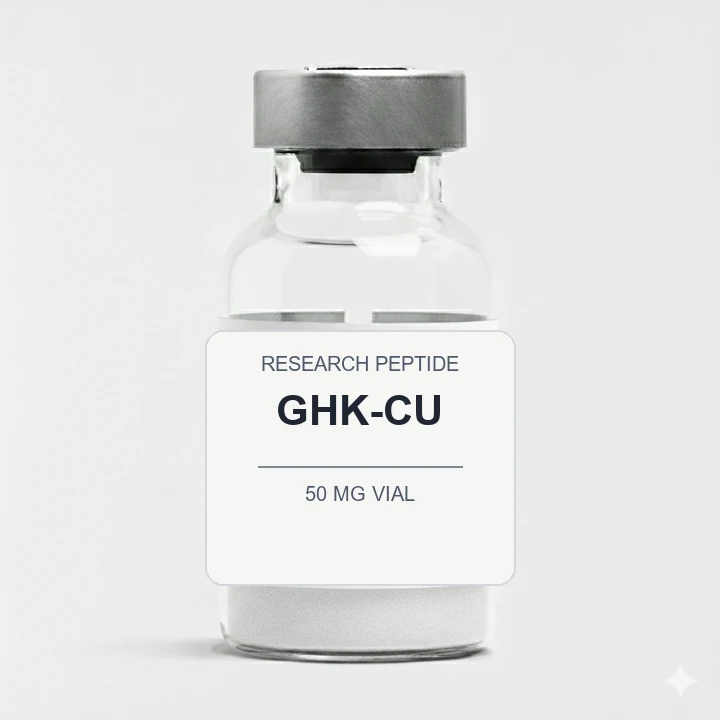
Quickstart Highlights
GHK-Cu (glycyl-L-histidyl-L-lysine:copper complex) is a naturally occurring copper peptide with documented roles in wound healing, tissue remodeling, and skin regeneration[1][2]. Research demonstrates activity in gene regulation related to collagen synthesis, antioxidant defense, and anti-inflammatory pathways[3][4]. This educational protocol presents practical subcutaneous administration approaches based on clinical practice patterns.
- Reconstitute: Add 3.0 mL sterile water → 16.67 mg/mL concentration.
- Typical range: 1.0–2.0 mg per injection (most common protocols use 5 days/week or 3×/week).
- Easy measuring: At 16.67 mg/mL, 1 unit = 0.01 mL ≈ 167 mcg on a U‑100 insulin syringe.
- Storage: Lyophilized: store at −20 °C (−4 °F) or below; reconstituted: refrigerate at 2–8 °C (35.6–46.4 °F) and use within 30 days.
Dosing & Reconstitution Guide
Educational guide for reconstitution and common dosing patterns
Standard / Conservative Approach (3 mL = 16.67 mg/mL; 5 days/week)
| Week/Phase | Dose per Injection | Units (per injection) (mL) |
|---|---|---|
| Weeks 1–4 | 1.0 mg (1000 mcg) | 6 units (0.06 mL) |
| Weeks 5–8 | 1.5 mg (1500 mcg) | 9 units (0.09 mL) |
| Weeks 9–12+ | 2.0 mg (2000 mcg) | 12 units (0.12 mL) |
Frequency: Inject once daily, 5 days per week subcutaneously[5][6]. This gradual titration allows assessment of individual tolerance while maintaining practical injection volumes. For ≤10‑unit (≤0.10 mL) administrations, consider 30‑ or 50‑unit insulin syringes for improved readability.
Reconstitution Steps
- Draw 3.0 mL sterile or bacteriostatic water with a sterile syringe.
- Inject slowly down the vial wall to minimize foaming.
- Gently swirl or roll the vial until the peptide fully dissolves (do not shake vigorously).
- Label with reconstitution date and refrigerate at 2–8 °C (35.6–46.4 °F), protected from light.
Alternative Protocol (3 mL = 16.67 mg/mL; 3× weekly)
| Week/Phase | Dose per Injection | Units (per injection) (mL) |
|---|---|---|
| Weeks 1–12+ | 2.0 mg (2000 mcg) | 12 units (0.12 mL) |
Frequency: Inject 2 mg three times per week (e.g., Monday/Wednesday/Friday)[6]. This protocol maintains consistent weekly dosing (~6 mg/week) with less frequent injections.
Supplies Needed
Plan based on an 8–16 week protocol. Calculations shown for both 5 days/week and 3×/week protocols.
-
Peptide Vials (GHK-Cu, 50 mg each):
- 5 days/week (1.0–2.0 mg/day):
- 8 weeks (~50 mg total) ≈ 1 vial
- 12 weeks (~90 mg total) ≈ 2 vials
- 16 weeks (~130 mg total) ≈ 3 vials
- 3×/week (2 mg each):
- 8 weeks (~48 mg) ≈ 1 vial
- 12 weeks (~72 mg) ≈ 2 vials
- 16 weeks (~96 mg) ≈ 2 vials
-
Insulin Syringes (U‑100, 29–31 gauge):
- 5 days/week:
- Per week: 5 syringes
- 8 weeks: 40 syringes
- 12 weeks: 60 syringes
- 16 weeks: 80 syringes
- 3×/week:
- Per week: 3 syringes
- 8 weeks: 24 syringes
- 12 weeks: 36 syringes
- 16 weeks: 48 syringes
-
Sterile or Bacteriostatic Water (10 mL bottles): Use ~3.0 mL per vial for reconstitution.
- 1 vial protocols: 3 mL → 1 × 10 mL bottle
- 2 vial protocols: 6 mL → 1 × 10 mL bottle
- 3 vial protocols: 9 mL → 1 × 10 mL bottle
-
Alcohol Swabs: One for the vial stopper + one for the injection site each administration.
- 5 days/week:
- Per week: 10 swabs (2 per injection)
- 8 weeks: 80 swabs → recommend 1 × 100‑count box
- 12 weeks: 120 swabs → recommend 2 × 100‑count boxes
- 16 weeks: 160 swabs → recommend 2 × 100‑count boxes
- 3×/week:
- Per week: 6 swabs
- 8 weeks: 48 swabs → recommend 1 × 100‑count box
- 12 weeks: 72 swabs → recommend 1 × 100‑count box
- 16 weeks: 96 swabs → recommend 1 × 100‑count box
Protocol Overview
Concise summary of common GHK-Cu administration patterns.
- Goal: Support tissue remodeling, wound healing, and skin regeneration through documented biological pathways[1][2].
- Schedule: Subcutaneous injections for 8–12 weeks (extend to 16 weeks if desired).
- Dose Range: 1.0–2.0 mg per injection; frequency 3–5 days per week.
- Reconstitution: 3.0 mL per 50 mg vial (16.67 mg/mL) provides practical unit measurements.
- Storage: Lyophilized frozen; reconstituted refrigerated and used within 30 days.
Dosing Protocol
Flexible approaches based on clinical practice patterns.
- Conservative (5 days/week): Start 1.0 mg daily; titrate to 1.5–2.0 mg over 4–8 weeks.
- Alternative (3×/week): Consistent 2.0 mg per injection for simplified scheduling.
- Route: Subcutaneous injection (abdomen, thighs, or upper arms).
- Cycle Length: 8–12 weeks typical; may extend to 16 weeks based on individual goals.
- Timing: Any consistent time of day; rotate injection sites systematically.
Storage Instructions
Proper storage maintains peptide stability and potency.
- Lyophilized (dry powder): Store at −20 °C (−4 °F) or lower in dry, dark conditions[7][8]. Keep vial tightly sealed with desiccant if possible to minimize moisture exposure.
- Reconstituted (in solution): Refrigerate at 2–8 °C (35.6–46.4 °F) and use within 30 days for optimal potency[9]. Bacteriostatic water helps inhibit bacterial growth.
- Aliquoting: For longer storage, divide solution into sterile vials and freeze at −20 °C (−4 °F)[10]. Avoid repeated freeze–thaw cycles as they degrade peptides over time[11].
- Allow vials to reach room temperature before opening to reduce condensation.
Important Notes
Practical considerations for safe and consistent administration.
- Use new sterile insulin syringes for each injection; dispose in proper sharps containers.
- Rotate injection sites (abdomen at least 1 inch from navel, outer thighs, upper arms) to prevent irritation and lipodystrophy[12][13].
- Clean injection site with alcohol swab and allow to air-dry completely before injecting[14].
- Inject slowly and steadily; withdraw needle at same angle as insertion.
- Document dose, date, and injection site to maintain consistency and track rotation.
How This Works
GHK-Cu is a naturally occurring tripeptide that complexes with copper ions to modulate numerous biological processes. Research has demonstrated its involvement in wound healing through enhanced collagen and decorin gene expression[1], activation of tissue remodeling pathways[2], and regulation of genes associated with antioxidant defense and anti-inflammatory responses[3][4]. Preclinical studies show GHK-Cu is active at very low doses in animals (approximately 0.5 mcg/kg in rodent models)[15], while clinical practice employs milligram-range dosing in humans to achieve systemic effects[5][6]. The peptide demonstrates multifunctional activity across skin, nervous system, and vascular tissue, with documented gene-regulatory effects that extend beyond simple wound healing[3][16].
Potential Benefits & Observed Effects
Documented effects from research literature and clinical observations.
- Supports wound healing and tissue repair through collagen synthesis and remodeling pathways[1][2].
- Demonstrates positive regulatory effects on genes related to antioxidant enzymes, growth factors, and anti-inflammatory signaling[3][4].
- Shows activity in nervous system function and cognitive pathways in preclinical models[16].
- Generally well tolerated; most common side effects are mild injection-site reactions (temporary redness, itching) with subcutaneous administration.
- No official human dosing guidelines exist as GHK-Cu is not FDA-approved; protocols are based on clinical practice and empirical use[5].
Lifestyle Factors
Complementary approaches to support tissue health and regeneration.
- Maintain adequate protein intake to support collagen synthesis and tissue repair processes.
- Ensure sufficient hydration and micronutrient status (particularly copper, zinc, vitamin C) for optimal connective tissue metabolism.
- Prioritize sleep quality and stress management to support regenerative biological processes.
- Consider combining with appropriate skincare or wound-care protocols as relevant to individual goals.
Injection Technique
Standard subcutaneous injection guidance from clinical best practices[17][18].
- Clean the vial stopper and injection site with alcohol swabs; allow both to air-dry completely[14].
- Pinch a fold of skin and insert the needle at 45–90° angle into subcutaneous tissue[17][18].
- Do not aspirate for subcutaneous injections; inject slowly and steadily[17].
- Withdraw the needle at the same angle as insertion; if needed, gently press site with cotton swab (do not rub)[19].
- Rotate injection sites systematically to prevent lipohypertrophy and local irritation[12][13].
- Dispose of used syringes immediately in a proper sharps container[19].
Important Note
This content is intended for therapeutic educational purposes only and does not constitute medical advice, diagnosis, or treatment.