

Quickstart Highlights
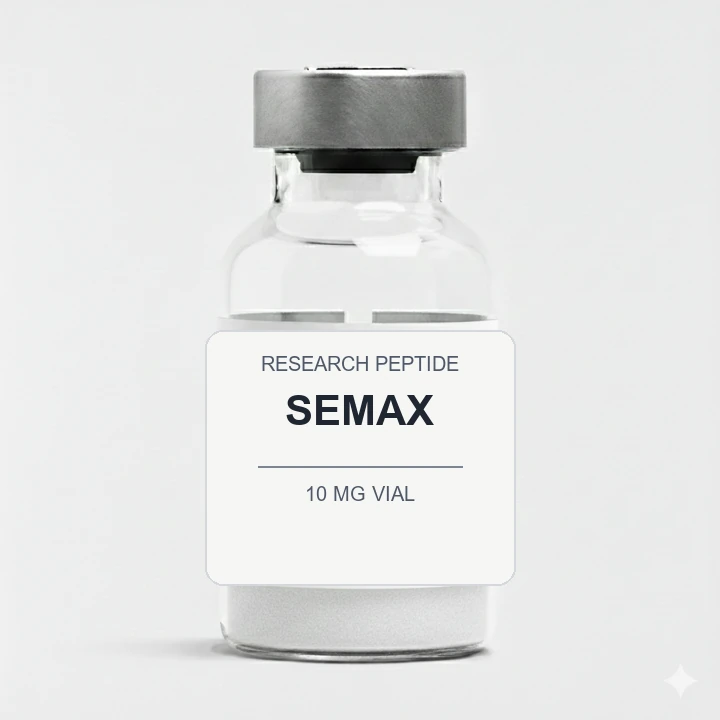
Semax is a synthetic heptapeptide analog of ACTH(4–10) developed in Russia and studied primarily for cognitive enhancement and neuroprotection[1][2]. While intranasal administration is most common in clinical literature, subcutaneous injection offers a convenient once‑daily alternative for research purposes[1][4]. This educational protocol presents a practical SC approach using straightforward reconstitution for accurate insulin‑syringe measurements.
- Reconstitute: Add 3.0 mL bacteriostatic water (max vial capacity) → ~3.33 mg/mL concentration.
- Typical daily range: 300–800 mcg once daily (gradual titration recommended).
- Easy measuring: At 3.33 mg/mL, 1 unit = 0.01 mL ≈ 33.3 mcg on a U‑100 insulin syringe.
- Storage: Lyophilized: freeze at −20 °C (−4 °F); after reconstitution, refrigerate at 2–8 °C (35.6–46.4 °F); avoid freeze–thaw cycles[2][9].
Dosing & Reconstitution Guide
Educational guide for reconstitution and daily dosing
Standard / Gradual Approach (3 mL = ~3.33 mg/mL)
| Week | Daily Dose (mcg) | Units (per injection) (mL) |
|---|---|---|
| Weeks 1–2 | 300 mcg | 9 units (0.09 mL) |
| Weeks 3–4 | 500 mcg | 15 units (0.15 mL) |
| Weeks 5–6 | 600 mcg | 18 units (0.18 mL) |
| Weeks 7–8 | 800 mcg | 24 units (0.24 mL) |
For ≤10‑unit (≤0.10 mL) administrations, consider 30‑ or 50‑unit insulin syringes for improved readability.
Frequency: Inject once daily subcutaneously[1][4]. This schedule uses the largest practical dilution (3.0 mL) to ensure per‑injection volumes are accurate and manageable. Most human nootropic studies use intranasal dosing in the range of 400–900 mcg/day divided into multiple administrations[2][3]; this SC protocol delivers comparable total daily amounts in a single injection for convenience.
Reconstitution Steps
- Draw 3.0 mL bacteriostatic water with a sterile syringe.
- Inject slowly down the vial wall; avoid foaming.
- Gently swirl/roll until dissolved (do not shake vigorously).
- Label and refrigerate at 2–8 °C (35.6–46.4 °F), protected from light[2].
Supplies Needed
Plan based on an 8–16 week daily protocol with gradual titration.
-
Peptide Vials (Semax, 10 mg each):
- 8 weeks ≈ 4 vials
- 12 weeks ≈ 6 vials
- 16 weeks ≈ 8 vials
-
Insulin Syringes (U‑100):
- Per week: 7 syringes (1/day)
- 8 weeks: 56 syringes
- 12 weeks: 84 syringes
- 16 weeks: 112 syringes
-
Bacteriostatic Water (10 mL bottles): Use ~3.0 mL per vial for reconstitution.
- 8 weeks (4 vials): 12 mL → 2 × 10 mL bottles
- 12 weeks (6 vials): 18 mL → 2 × 10 mL bottles
- 16 weeks (8 vials): 24 mL → 3 × 10 mL bottles
-
Alcohol Swabs: One for the vial stopper + one for the injection site each day.
- Per week: 14 swabs (2/day)
- 8 weeks: 112 swabs → recommend 2 × 100‑count boxes
- 12 weeks: 168 swabs → recommend 2 × 100‑count boxes
- 16 weeks: 224 swabs → recommend 3 × 100‑count boxes
Protocol Overview
Concise summary of the once‑daily SC regimen.
- Goal: Support cognitive function, attention, and neuroprotective pathways studied in clinical literature[2][5].
- Schedule: Daily subcutaneous injections for 8 weeks (extend to 12–16 weeks with cycling if desired)[4].
- Dose Range: 300–800 mcg daily with gradual titration; aligns with typical human nootropic dosing ranges[2][3].
- Reconstitution: 3.0 mL per 10 mg vial (~3.33 mg/mL) for accurate unit measurements.
- Storage: Lyophilized frozen; reconstituted refrigerated; use within 30 days[2][9].
Dosing Protocol
Suggested daily titration approach.
- Start: 300 mcg daily; increase by ~100–200 mcg every 1–2 weeks as tolerated.
- Target: 600–800 mcg daily by Weeks 5–8; adjust based on individual response.
- Frequency: Once per day (subcutaneous)[1][4].
- Cycle Length: 8 weeks continuous; optional extension to 12–16 weeks with off‑periods (e.g., 6 weeks on, 2 weeks off)[4].
- Timing: Any consistent time; rotate injection sites systematically.
Storage Instructions
Proper storage preserves peptide quality.
- Lyophilized: Store at −20 °C (−4 °F) in dry, dark conditions[9]; minimize moisture exposure.
- Reconstituted: Refrigerate at 2–8 °C (35.6–46.4 °F); stable for up to 30 days[2][9]; avoid freeze–thaw cycles.
- Allow vials to reach room temperature before opening to reduce condensation uptake.
- Protect from light; wrap vials in foil or store in an opaque container[9].
Important Notes
Practical considerations for consistency and safety.
- Use new sterile insulin syringes for each injection; dispose in a sharps container[7].
- Rotate injection sites (abdomen, thighs, upper arms) at least 1–2 inches from previous sites to reduce local irritation[7].
- Inject slowly; wait a few seconds before withdrawing the needle.
- Document daily dose, injection time, and site rotation to maintain consistency.
- Most human data are for 4–8 weeks of continuous use; longer protocols should incorporate rest periods[4].
How This Works
Semax is a synthetic analog of the ACTH(4–10) fragment with a C‑terminal Pro‑Gly‑Pro tripeptide extension that enhances metabolic stability[1][5]. Clinical and preclinical literature suggest it modulates brain‑derived neurotrophic factor (BDNF) expression, enhances cholinergic and dopaminergic neurotransmission, and exhibits neuroprotective properties in models of cerebrovascular and cognitive impairment[2][5]. Human studies in Russia have employed Semax for cognitive support in conditions ranging from mild cognitive impairment to acute stroke recovery, typically using intranasal administration[2][3][6]. Subcutaneous delivery offers an alternative route with potentially more sustained systemic absorption[1][4].
Potential Benefits & Side Effects
Observations from preclinical and clinical literature.
- May support attention, memory consolidation, and learning in clinical populations with cognitive deficits[2][5].
- Studied in neurological conditions including stroke, traumatic brain injury, and optic neuropathy with favorable safety profiles in month‑long human trials[2][3][6].
- Generally well tolerated; intranasal administration may cause minor nasal irritation; subcutaneous injection may produce mild injection‑site reactions (redness, itching).
- No significant elevations in cortisol or other adverse endocrine effects reported in clinical studies[2].
- Effects are dose‑dependent; titration helps identify the minimum effective dose for individual response[2].
Lifestyle Factors
Complementary strategies for optimal cognitive support.
- Maintain consistent sleep schedules and prioritize 7–9 hours of quality sleep per night.
- Engage in regular aerobic exercise and cognitive training to reinforce neuroplastic adaptations.
- Follow a balanced diet rich in omega‑3 fatty acids, antioxidants, and micronutrients that support brain health.
- Manage stress through mindfulness, meditation, or other relaxation techniques.
- Stay mentally active with challenging tasks, learning new skills, and social engagement.
Injection Technique
General subcutaneous guidance from clinical best‑practice resources[7][8][9].
- Clean the vial stopper and injection site with alcohol swabs; allow to dry completely.
- Pinch a 1–2 inch skinfold; insert the needle at 45–90° into subcutaneous tissue (angle depends on needle length and fat layer)[7].
- Do not aspirate for subcutaneous injections; inject slowly and steadily[7][8].
- Withdraw the needle at the same angle; apply gentle pressure with clean gauze (do not rub vigorously)[7].
- Rotate sites systematically (abdomen, thighs, upper arms) to avoid lipohypertrophy or tissue irritation; maintain at least 1–2 inches between injection sites[7].
- Dispose of used syringes immediately in a proper sharps container[7].
Important Note
This content is intended for therapeutic educational purposes only and does not constitute medical advice, diagnosis, or treatment.